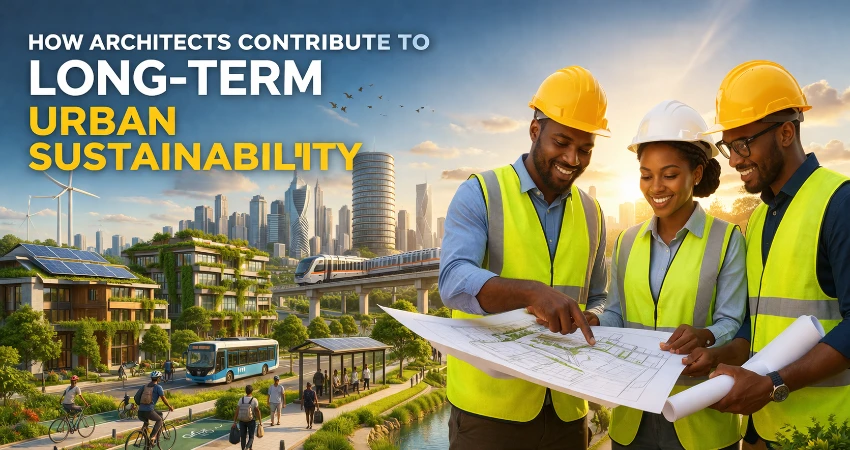
Cities shape how people live, move, and consume resources. When you design a building, you influence more than one plot of land. You affect energy demand, water use, transport patterns, and public health for decades. Architects hold a central role in long-term urban sustainability because design decisions made today lock in environmental and social outcomes for years to come.
Urban areas account for over 70 percent of global CO₂ emissions, according to UN-Habitat. A large share of those emissions comes from buildings and infrastructure. This means your design choices directly affect how cities respond to climate pressures. Sustainability is not an abstract goal. It is a measurable responsibility.
Designing for Energy Performance
Architects shape how much energy a building will consume long before engineers size mechanical systems. Orientation, massing, shading, and window placement determine solar gain and natural light levels. When you prioritize passive design, you reduce reliance on mechanical cooling and artificial lighting.
In tropical contexts, for example, proper cross-ventilation and shading can significantly lower indoor temperatures. The International Energy Agency reports that cooling demand could triple by 2050 without stronger efficiency measures. If your building depends entirely on air conditioning, you add pressure to already strained energy grids. If you design for airflow and daylight first, you reduce long-term operational demand.
At Renaissance Africa, we address these issues during Architectural Consultancy and Planning & Design. We assess orientation, prevailing winds, and sun paths at the earliest stage. These decisions cost little to implement on paper but deliver long-term benefits in operation.
Supporting Compact and Connected Cities
Urban sustainability depends on how buildings relate to streets and public transport. Architects influence density, mixed-use integration, and pedestrian experience. When you design developments that support walkability and public transit, you reduce car dependency.
Ask yourself: Does your project encourage people to walk to nearby services, or does it force them to drive? Do you provide shaded sidewalks, safe entrances, and active ground floors? Or do you create blank walls and isolated compounds?
Mixed-use projects offer a practical example. When residential, retail, and office spaces share a site, daily travel distances shrink. This approach reduces emissions and strengthens local economies. It also improves safety through consistent activity throughout the day.
Managing Water and Stormwater Responsibly
Water management plays a critical role in urban resilience. Poor drainage planning leads to flooding, infrastructure damage, and public health risks. Architects can integrate permeable surfaces, green roofs, and rainwater harvesting systems into their designs.
When you design with permeable paving, bioswales, and planted areas, you allow water to infiltrate the ground instead of overwhelming drainage systems.
In our Research & Feasibility Studies, we examine site topography and local rainfall data before finalizing design strategies. These studies inform grading plans and landscape integration so that water management supports long-term performance rather than reacting to problems later.
Choosing Materials with Long-Term Impact in Mind
Material selection influences both embodied carbon and durability. Concrete and steel carry high carbon footprints. Recycled content, locally sourced materials, and low-carbon alternatives reduce environmental impact.
You also need to consider lifespan. A cheaper material that fails after ten years may create more waste and cost than a durable alternative. Long-term sustainability depends on lifecycle thinking. During Contract Administration and Project Supervision, we verify that specified materials meet agreed standards. Substitutions without review can undermine sustainability goals.
Think about your current project. Are you selecting materials based only on upfront cost? Or are you evaluating maintenance, replacement cycles, and environmental impact over time?
Designing for Adaptability
Cities evolve. Buildings that cannot adapt often become obsolete and face demolition. Demolition generates waste, and new construction demands more resources. Architects contribute to sustainability when they design flexible spaces that accommodate change.
Open floor plates, modular partitions, and accessible service zones allow buildings to shift functions over time. An office building may convert to residential use. A retail space may become a clinic or community center. When you anticipate change, you extend a building’s lifespan and reduce environmental impact.
At Renaissance Africa, adaptability informs our Planning & Design approach. We encourage clients to think beyond immediate needs. What will this building require in 20 or 30 years? How can structural grids and service layouts support future shifts?
Promoting Social Sustainability
Urban sustainability goes beyond environmental performance. It includes access, safety, and public well-being. Architects influence how people interact with space. Natural light, ventilation, and public gathering areas improve health and social cohesion.
When you design buildings that prioritize daylight, airflow, and inclusive access, you support community well-being.
Public spaces also matter. Courtyards, plazas, and shaded seating areas encourage interaction. These features strengthen social ties and support local identity. Ask yourself whether your project contributes to community life or isolates its users from the surrounding city.
Integrating Supervision with Sustainability Goals
Design intent alone does not guarantee sustainable outcomes. Construction quality determines actual performance. Poorly installed insulation, incorrect window glazing, or blocked ventilation paths can compromise energy targets.
Through Project Supervision, we ensure that sustainability measures are executed correctly on site. We review installations, verify materials, and address deviations early. This protects your investment and maintains alignment with long-term urban sustainability goals.
A Responsibility That Extends Beyond the Site
Architects contribute to long-term urban sustainability by shaping energy demand, mobility patterns, water systems, material use, and social interaction. Each decision influences the city’s environmental and social footprint.
You do not need large budgets or complex technology to make meaningful contributions. You need clarity of purpose and disciplined execution. Start by asking direct questions at the concept stage. How will this building perform in 30 years? How will it interact with its neighborhood? What resources will it consume over its lifetime?
When you approach each project with these questions in mind, you move beyond short-term deliverables. You shape cities that function better for current residents and future generations.

Renaissance Africa
Your trusted architectural firm delivering innovative, sustainable, and cost-effective design solutions across residential, commercial, institutional, and hospitality projects in Kenya.